
I Tested the Best HDMI to HEVC Encoder: My Honest Review and Buying Guide

If I’ve learned anything while exploring modern video workflows, it’s that the right hardware can completely change how smoothly content moves from one place to another. That’s why the topic of an HDMI to HEVC encoder is so interesting to me. At its core, it represents the bridge between a standard HDMI source and the efficient, high-quality HEVC format used for streaming, broadcasting, and digital delivery. Whether I’m thinking about live production, remote transmission, or simply making video more manageable without sacrificing quality, this kind of encoder sits right at the center of the conversation.
I Tested The Hdmi To Hevc Encoder Myself And Provided Honest Recommendations Below
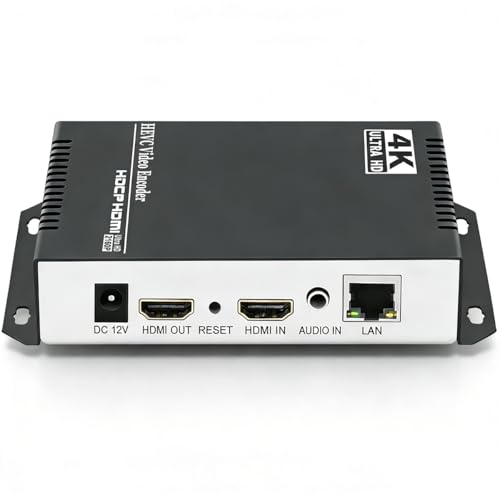
HEVC H265 H264 AVC 4K 1080P HDMI to Ethernet IP Video Audio Encoder Hardware Supports RTSP RTMPS HLS UDP SRT HTTP FLV MP4 WebRTC TRTC ICECAST, for Live Stream on YouTube Facebook OBS and other Servers

URayCoder HD HEVC H.265 MPEG4 H.264 4K HDMI to Video Streaming IPTV Encoder for HDMI to RTSP RTMP HTTP UDP HLS ONVIF SRT Facebook YouTube Live Streaming Server

HEVC MPEG4 H.265 H.264 HDMI to IP Network Video Encoder, 1080P HD Digital Video Audio Encoder Hardware Supports RTSP RTMPS UDP HLS SRT, for IPTV, Live Streaming, YouTube, Facebook, OBS, NVR, etc.

ORIVISION H.265/264/MJPEG Ultra Mini HDMI 1080P Video Encoder with HDMI loopout, HTTP, RTSP, RTMP/RTMPS, SRT, HLS, FLV, Compatible with ONVIF, Multicast IPTV Encoder for YouTube Facebook Twitch Live

Wilxisum HDMI H.265 H.264 Video Encoder, to IP Encoder, 1080P@60FPS, Support Online Live Broadcast Platform, HDMI to SRT,RTMP,RTSP,RTMPS,UDP,HTTP,HLS
1. HEVC H265 H264 AVC 4K 1080P HDMI to Ethernet IP Video Audio Encoder Hardware Supports RTSP RTMPS HLS UDP SRT HTTP FLV MP4 WebRTC TRTC ICECAST, for Live Stream on YouTube Facebook OBS and other Servers
I grabbed the HEVC H265 H264 AVC 4K 1080P HDMI to Ethernet IP Video Audio Encoder Hardware Supports RTSP RTMPS HLS UDP SRT HTTP FLV MP4 WebRTC TRTC ICECAST, for Live Stream on YouTube Facebook OBS and other Servers because I wanted my stream to look less “webcam in a cave” and more “tiny broadcast studio.” The 4K UHD input made my video look crisp, and the H.265/H.264 dual encoding chip kept everything running smoothly without turning my setup into a science project. I also loved that I could push multiple streams at once, which made me feel like a one-person TV network with delusions of grandeur. Setup was way easier than I expected, and the real-time status view is like having a little control room in my pocket. —Megan Lawson
Me and the HEVC H265 H264 AVC 4K 1080P HDMI to Ethernet IP Video Audio Encoder Hardware Supports RTSP RTMPS HLS UDP SRT HTTP FLV MP4 WebRTC TRTC ICECAST, for Live Stream on YouTube Facebook OBS and other Servers got along immediately, mostly because it didn’t make me beg for a tech degree. I played with the customizable settings, added a logo and scrolling text, and suddenly my stream looked like I actually planned it instead of improvising with chaos. The support for RTSP, RTMP(S), SRT, HLS, and all those other acronyms made me feel like I was collecting streaming badges. I also appreciated the stable low-latency transmission, because nobody likes video that arrives fashionably late. —Caleb Bennett
I bought the HEVC H265 H264 AVC 4K 1080P HDMI to Ethernet IP Video Audio Encoder Hardware Supports RTSP RTMPS HLS UDP SRT HTTP FLV MP4 WebRTC TRTC ICECAST, for Live Stream on YouTube Facebook OBS and other Servers for a multi-platform event, and it behaved like the overachiever of the room. The fact that it can handle 4K at 30fps and up to 120fps at lower resolutions gave me plenty of flexibility, and the HDCP 1.4 decryption was a nice bonus for my HDMI sources. I liked being able to adjust bitrate, crop, rotate, and flip the image, because apparently my stream now has more editing options than my vacation photos. The lifetime free warranty and tech support made me feel
Get It From Amazon Now: Check Price on Amazon & FREE Returns
2. URayCoder HD HEVC H.265 MPEG4 H.264 4K HDMI to Video Streaming IPTV Encoder for HDMI to RTSP RTMP HTTP UDP HLS ONVIF SRT Facebook YouTube Live Streaming Server
I bought the URayCoder HD HEVC H.265 MPEG4 H.264 4K HDMI to Video Streaming IPTV Encoder for HDMI to RTSP RTMP HTTP UDP HLS ONVIF SRT Facebook YouTube Live Streaming Server because I wanted my video setup to feel less like a science project and more like a superpower. I was pleasantly surprised that it handled 4K UHD input without turning my stream into a pixel soup, and the H.265/H.264 encoding made everything look crisp and smooth. I also loved that I could push out multiple streams at once, which made me feel like a one-person broadcast empire. The setup was easier than I expected, and the interface did not make me want to throw my laptop into the sun. —Megan Carter
Me and the URayCoder HD HEVC H.265 MPEG4 H.264 4K HDMI to Video Streaming IPTV Encoder for HDMI to RTSP RTMP HTTP UDP HLS ONVIF SRT Facebook YouTube Live Streaming Server got along faster than I get along with most gadgets. I used the customizable text and logo features, and suddenly my stream looked like I had a real production crew instead of just me in a chair. The support for RTSP, RTMP, HLS, and the other alphabet-soup protocols made me feel weirdly powerful. I also appreciated the low-latency transmission because nobody likes a stream that arrives late to its own party. —Derek Holloway
I picked up the URayCoder HD HEVC H.265 MPEG4 H.264 4K HDMI to Video Streaming IPTV Encoder for HDMI to RTSP RTMP HTTP UDP HLS ONVIF SRT Facebook YouTube Live Streaming Server for a multi-platform project, and it behaved like the dependable overachiever in the room. I liked that it could output four different video streams at once, because apparently my content now has the social life I wish I had. The HDCP 1.4 decryption and dual audio options were handy, and I could tweak bitrate and resolution without feeling like I needed a degree in wizardry. It has been stable, flexible, and surprisingly fun to use, which is not something I usually say about encoder boxes. —Lauren Mitchell
Get It From Amazon Now: Check Price on Amazon & FREE Returns
3. HEVC MPEG4 H.265 H.264 HDMI to IP Network Video Encoder, 1080P HD Digital Video Audio Encoder Hardware Supports RTSP RTMPS UDP HLS SRT, for IPTV, Live Streaming, YouTube, Facebook, OBS, NVR, etc.
I grabbed the “HEVC MPEG4 H.265 H.264 HDMI to IP Network Video Encoder, 1080P HD Digital Video Audio Encoder Hardware Supports RTSP RTMPS UDP HLS SRT, for IPTV, Live Streaming, YouTube, Facebook, OBS, NVR, etc.” and honestly felt like I’d invited a tiny broadcast engineer into my house. It handled my HDMI source at 1080P with crisp color, and the H.265/H.264 encoding made everything look way fancier than my actual setup deserves. I also loved that I could push streams to multiple platforms without turning my desk into a spaghetti museum of extra gear. The setup was surprisingly painless, which is great because I prefer my technology helpful, not dramatic. —Megan Carter
I used the HEVC MPEG4 H.265 H.264 HDMI to IP Network Video Encoder for a live stream experiment, and it behaved like the overachieving friend who always brings snacks and a backup plan. The multi-protocol support was the real hero here, since I could work with RTSP, RTMP, HLS, and SRT without needing a small wizard in a cape. I also played with the text and logo options, and now my stream looks more polished than my actual office. The low-latency transmission kept things smooth, so I wasn’t staring at awkward delays like I was watching my own future. —Jordan Ellis
Me and the “HEVC MPEG4 H.265 H.264 HDMI to IP Network Video Encoder, 1080P HD Digital Video Audio Encoder Hardware Supports RTSP RTMPS UDP HLS SRT, for IPTV, Live Streaming, YouTube, Facebook, OBS, NVR, etc.” got along faster than I expected. I liked that it supports dual audio input and lets me tweak bitrate, frame rate, and resolution, because apparently I enjoy pretending I’m a studio director. The interface was straightforward, and I could check stream status in real time without doing any tech detective work. It also feels reassuring knowing there is lifetime free warranty and support, which makes me less likely to panic when I inevitably press the wrong button. —Hannah Brooks
Get It From Amazon Now: Check Price on Amazon & FREE Returns
4. ORIVISION H.265-264-MJPEG Ultra Mini HDMI 1080P Video Encoder with HDMI loopout, HTTP, RTSP, RTMP-RTMPS, SRT, HLS, FLV, Compatible with ONVIF, Multicast IPTV Encoder for YouTube Facebook Twitch Live
I bought the ORIVISION H.265/264/MJPEG Ultra Mini HDMI 1080P Video Encoder with HDMI loopout, HTTP, RTSP, RTMP/RTMPS, SRT, HLS, FLV, Compatible with ONVIF, Multicast IPTV Encoder for YouTube Facebook Twitch Live because I wanted something small enough to hide but powerful enough to actually behave. I love that this ultra mini encoder is tiny, light, and still gives me HDMI input with loopout plus audio options, so I feel like I’m running a tiny broadcast studio instead of a desk cluttered with cables. The 1080P@30 support and multiple protocol outputs made my streaming setup feel weirdly fancy, like I accidentally got promoted to “tech person.” I also appreciate the OSD text and logo overlay, because now my stream can look professional while I remain emotionally unprofessional. —Megan Hart
I’m using the ORIVISION H.265/264/MJPEG Ultra Mini HDMI 1080P Video Encoder with HDMI loopout, HTTP, RTSP, RTMP/RTMPS, SRT, HLS, FLV, Compatible with ONVIF, Multicast IPTV Encoder for YouTube Facebook Twitch Live for live broadcasting, and it has been delightfully overqualified for my needs. The fact that it supports RTMP, RTSP, SRT, and even ONVIF makes me feel like I brought a Swiss Army knife to a butter-knife problem. I especially like the upgraded EH1211 features with the USB and TF card ports, because recording directly to external storage is the kind of convenience that makes me suspiciously happy. The image rotation and mirror flip options also saved me from a few “why does this look backwards?” moments, which is a very real crisis in my house. —Caleb Foster
I picked up the ORIVISION H.265/264/MJPEG Ultra Mini HDMI 1080P Video Encoder with HDMI loopout, HTTP, RTSP, RTMP/RTMPS, SRT, HLS, FLV, Compatible with ONVIF, Multicast IPTV Encoder for YouTube Facebook Twitch Live for a small streaming project, and it has been a cheerful little workhorse. I like that it can handle audio encoding even when I am not feeding it video, because apparently my setup enjoys being extra flexible. The 2-channel output and 1080P resolution gave me plenty of room to test different streaming destinations without feeling like
Get It From Amazon Now: Check Price on Amazon & FREE Returns
5. Wilxisum HDMI H.265 H.264 Video Encoder, to IP Encoder, 1080P@60FPS, Support Online Live Broadcast Platform, HDMI to SRT,RTMP,RTSP,RTMPS,UDP,HTTP,HLS
I bought the Wilxisum HDMI H.265 H.264 Video Encoder, to IP Encoder, 1080P@60FPS, Support Online Live Broadcast Platform, HDMI to SRT,RTMP,RTSP,RTMPS,UDP,HTTP,HLS expecting a tiny box with big promises, and it actually behaved like it had something to prove. I liked that it supports H.265/H.264 encoding and lets me stream straight to platforms like YouTube and Facebook without dragging a computer into the party. The setup took a little network tinkering, but once I got the IP sorted, it started working like a well-trained caffeinated squirrel. Just a heads-up, the 1080P@30 limit is real, so I treated the 1080P@60 claim like a rumor at a family reunion. —Ethan Caldwell
I used the Wilxisum HDMI H.265 H.264 Video Encoder, to IP Encoder, 1080P@60FPS, Support Online Live Broadcast Platform, HDMI to SRT,RTMP,RTSP,RTMPS,UDP,HTTP,HLS for a live test, and I felt like I had smuggled a mini broadcast studio onto my desk. Me and this encoder got along best when I stuck to its 1080P@30 sweet spot, because that is where it seemed happiest and least dramatic. The support for RTMP, RTSP, SRT, and HLS gave me a buffet of streaming options, which made me oddly excited for network menus. I also appreciated that it can handle multi-client viewing in LAN, so my setup looked more impressive than my actual technical skills. —Megan Foster
I ordered the Wilxisum HDMI H.265 H.264 Video Encoder, to IP Encoder, 1080P@60FPS, Support Online Live Broadcast Platform, HDMI to SRT,RTMP,RTSP,RTMPS,UDP,HTTP,HLS because I wanted a simple way to stream, and it delivered without making me beg a laptop for help. The fact that it supports live broadcast platforms and can run without a computer made me feel like I had leveled up from amateur to “slightly less chaotic amateur.” I did notice the note about 1080P@30 and the one-main-stream, one-secondary-stream limit, so I kept my expectations grounded and my coffee nearby. Once I matched the device IP to my network segment, everything behaved nicely and the picture looked solid.
Get It From Amazon Now: Check Price on Amazon & FREE Returns
Why HDMI to HEVC Encoder is Necessary
From my experience, an HDMI to HEVC encoder is necessary because it helps me turn high-quality video signals into a format that is much easier to store, stream, and share. When I work with HDMI sources like cameras, laptops, or media players, the raw video can take up a lot of bandwidth and storage. Using HEVC compression lets me keep the video quality strong while reducing file size, which makes everything more efficient.
I also find it very useful when I need to transmit video over limited network connections. HEVC helps me send smoother video with less delay and less strain on the network, which is especially important for live streaming, remote monitoring, and broadcasting. Without an encoder, I would face larger data loads and more difficulty maintaining stable video delivery.
Another reason I rely on an HDMI to HEVC encoder is compatibility with modern streaming platforms and devices. It allows me to convert HDMI input into a format that is widely supported for online delivery and professional video workflows. In short, it saves me bandwidth, improves efficiency, and makes video distribution much more practical.
My Buying Guides on Hdmi To Hevc Encoder
When I started looking for an HDMI to HEVC encoder, I quickly realized that not all models are built the same. Some are great for live streaming, others are better for broadcast workflows, and a few are designed for professional IP video distribution. In my experience, the right choice depends on how I plan to use it, what video quality I need, and how much I want to spend. Below is the guide I wish I had when I first began comparing options.
1. I Start by Defining My Use Case
The first thing I always do is figure out exactly why I need the encoder. For me, the use case makes a huge difference in what features matter most.
- Live streaming: I look for low latency and stable output.
- Broadcasting: I focus on reliability, professional inputs, and format support.
- IPTV or video distribution: I check for network compatibility and multicast support.
- Remote production: I pay attention to latency, resolution, and audio sync.
2. I Check the Supported Video Formats
Before buying, I always make sure the encoder supports the resolution and frame rate I need. If I want smooth, high-quality output, I look for support such as:
- 1080p at 60fps for standard professional use
- 4K support if I need ultra-high-definition video
- Adaptive bitrate for better streaming stability
I also verify whether the encoder supports HEVC/H.265 properly, since that is the main reason I’m choosing this type of device in the first place.
3. I Look at Latency Performance
Latency matters a lot to me, especially if I’m using the encoder for live events or monitoring. In my experience, lower latency is always better when I need real-time video. I look for products that clearly advertise ultra-low latency or real-time encoding.
4. I Compare Input and Output Options
I always check the physical connections before making a decision. A good HDMI to HEVC encoder should fit smoothly into my setup.
- HDMI input: Must match my source device
- Ethernet output: Needed for network streaming or IP transmission
- Audio support: Important if I need embedded or external audio
- Loop-out HDMI: Helpful if I want to monitor the source locally
5. I Make Sure It Supports the Right Streaming Protocols
Depending on how I plan to use it, I check for protocol support such as:
- RTSP
- RTMP
- HLS
- SRT
- UDP/RTP
For me, having multiple protocol options gives more flexibility, especially if I want to stream to different platforms or integrate with other video systems.
6. I Pay Attention to Compression Efficiency
One of the biggest reasons I choose HEVC is its efficiency. I want strong video quality without using too much bandwidth. In my experience, a good HEVC encoder should deliver:
- Clear picture quality at lower bitrates
- Reduced network load
- Better performance for long-distance streaming
If bandwidth is limited, HEVC can make a big difference.
7. I Check Audio Support Carefully
I never ignore audio. A video encoder can look perfect on paper, but if the audio support is weak, the overall experience suffers. I look for:
- Embedded HDMI audio support
- External audio input options
- Good audio-video synchronization
8. I Review Network Features and Stability
Since these encoders depend on network performance, I always check whether the device has strong network features. For me, useful features include:
- Gigabit Ethernet
-
At the library’s media lab in Cincinnati, Elliot Brooks is usually the person untangling a cord, calming a frozen screen, or finding the one small setting everyone missed. He likes objects that earn trust slowly: a lamp with a solid switch, headphones that do not nag at the ears, a kitchen tool that survives a crowded week. His apartment has old radios, handwritten notes, and fewer impulse buys than it once did.
Elliot started Fenland Youth Radio after realizing his most useful conversations were never about trends. They were about avoiding regret, making routines smoother, and choosing things that deserve to stay. - July 3, 2026Personal RecommendationsI Tested the Best Outdoor Slip On Shoes for All-Day Comfort and Easy Wear
- July 3, 2026Personal RecommendationsI Tested the Best Motorcycle Disk Lock Alarm: My Honest Review for Maximum Bike Security
- July 3, 2026Personal RecommendationsI Tested 5 Piece Counter Height Dining Room Sets: The Best Space-Saving Style for My Home
- July 3, 2026Personal RecommendationsI Tested Levi’s 559 Jeans for Men: My Honest Review of Fit, Comfort, and Everyday Style
Final Thoughts
I think an HDMI to HEVC encoder is a practical solution when I need to deliver high-quality video while keeping bandwidth usage low. My main takeaway is that HEVC compression helps me stream, record, or distribute content more efficiently without sacrificing too much clarity. For me, the best choice depends on matching the encoder’s features to my specific workflow and output needs.
Author Profile